
Prenatal tests
Prenatal tests make it possible to estimate, early and safely, the risk of certain chromosomal abnormalities during pregnancy. At Laboratorio Aclimu, we support you with technology that analyzes fetal DNA in the mother's blood and with first-trimester biochemical tests, always with clear information and counseling. These are screening tests: they provide guidance, but they do not diagnose on their own.
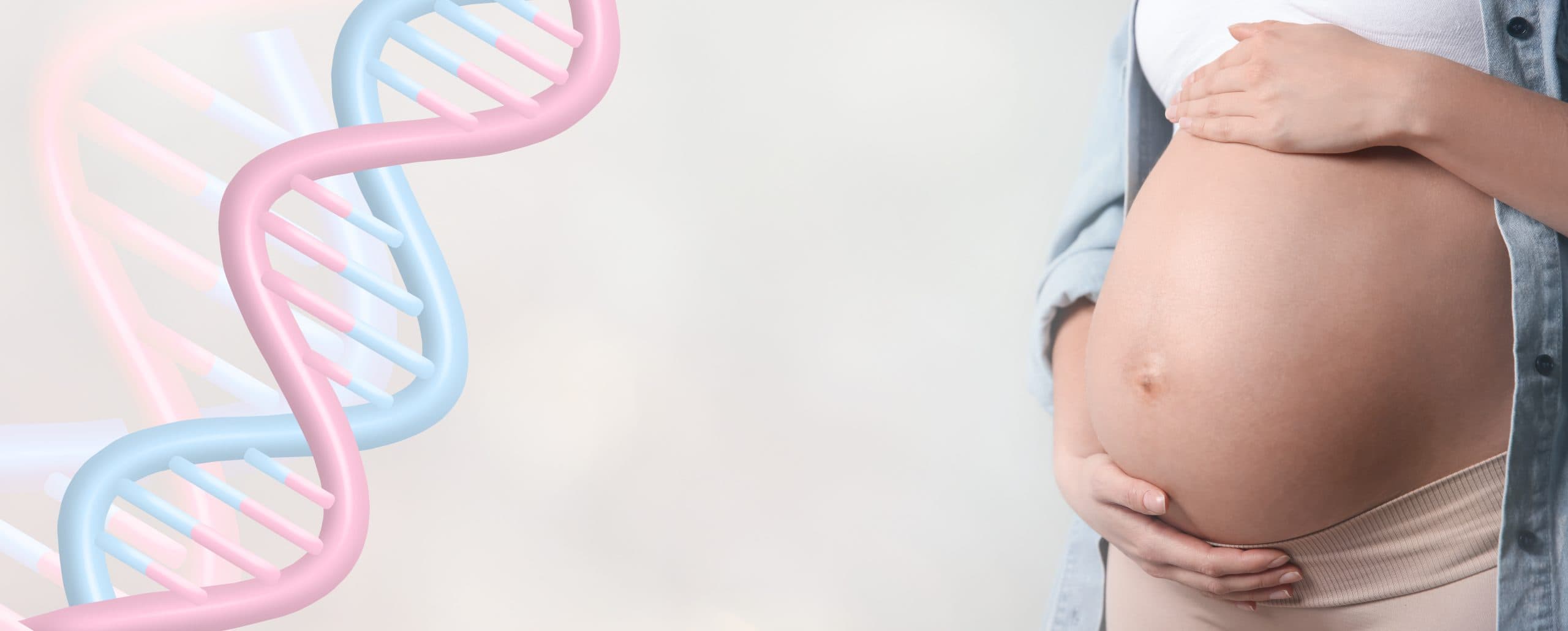
What is non-invasive prenatal testing (NIPT)?
Non-invasive prenatal testing, known by its acronym NIPT (Non-Invasive Prenatal Testing), analyzes small fragments of DNA from the pregnancy that circulate freely in the pregnant person's blood. Because it only requires a maternal blood draw, it carries no risk of pregnancy loss, unlike invasive procedures.
At Aclimu we offer two versions. Basic NIPT assesses the risk of the most common trisomies (21, 18, and 13) and of sex chromosome abnormalities. Expanded NIPT adds the analysis of microdeletions and other chromosomes. In both cases, it is a screening test: it estimates a risk; it does not confirm a diagnosis. Sensitivity for trisomy 21 is very high (>99%); for sex chromosome aneuploidies (Turner, Klinefelter) and microdeletions, sensitivity and positive predictive value are lower, and a positive result always requires diagnostic confirmation.
What does it detect, and how early can it be done?
NIPT is mainly designed to estimate the risk of trisomy 21 (Down syndrome), trisomy 18 (Edwards syndrome), and trisomy 13 (Patau syndrome), which are among the most common chromosomal abnormalities. Expanded NIPT also assesses microdeletions and additional chromosomes. It is important to know what it does NOT do: it does not replace ultrasounds or obstetric checkups, and it does not detect every possible congenital condition.
Analysis of fetal DNA in the mother's blood is generally done starting at week 9 to 10 of pregnancy, once there is enough DNA from the pregnancy circulating in the blood. The medical society ACOG recommends offering cell-free DNA screening to all pregnant people, regardless of age or prior risk level. The exact timing should always be decided with your regular healthcare provider.
Screening vs. diagnosis: why a high-risk result needs confirmation
This is important to understand clearly: NIPT is a screening test, not a diagnostic test. According to the American College of Obstetricians and Gynecologists (ACOG), cell-free DNA testing is the most sensitive screening test for the most common aneuploidies, but it is not the same as a diagnostic test. It can produce false-positive and false-negative results.
This means that a high-risk result does not, on its own, confirm that the baby has a chromosomal abnormality, and a low-risk result does not completely rule one out. If you get a high-risk result, international recommendations advise talking with your medical team and considering a confirmatory diagnostic test, such as chorionic villus sampling or amniocentesis, ideally with genetic counseling.
Fetal sex determination (fetal sexing) and biochemical tests (free β-hCG + PAPP-A)
Fetal sex determination identifies the baby's sex by looking for Y-chromosome sequences in the fetal DNA present in the mother's blood. It is usually done starting at week 9 of pregnancy, when the technique's reliability is high, with a simple blood draw and no prescription needed.
Separately, first-trimester biochemical screening combines markers in the mother's blood (the free fraction of β-hCG [human chorionic gonadotropin] and the protein PAPP-A) with maternal age and ultrasound data such as nuchal translucency. According to a study carried out at a public maternity hospital in Argentina, this combined screening is performed between weeks 11 and 13.6 and makes it possible to estimate whether the risk of aneuploidy is increased or decreased; it is a screening method, not a diagnosis.
At Laboratorio Aclimu (Buenos Aires), we combine up-to-date technology for analyzing fetal DNA in the mother's blood with online appointment booking and support to help you interpret your results and plan the next steps together with your medical team.
Frequently asked questions
Do I need a prescription to get a prenatal test?
Fetal sex determination (fetal sexing) can be done with no prescription needed, starting at week 9, with a simple blood draw. For NIPT and biochemical tests, we recommend talking with your obstetrician, who will recommend the most suitable test and help interpret the result. If you have questions, write to us and we'll point you in the right direction.
From what week of pregnancy can I get NIPT?
Analysis of fetal DNA in the mother's blood is generally done starting at week 9 to 10 of pregnancy, when there is already enough DNA from the pregnancy circulating in the blood. First-trimester biochemical screening (free β-hCG and PAPP-A) is usually done between weeks 11 and 13.6. The exact timing should be decided with your healthcare provider.
Is NIPT a diagnosis or a screening test?
It is a screening test, not a diagnosis. It estimates the risk of certain chromosomal abnormalities with very good sensitivity, but according to ACOG it is not the same as a diagnostic test, and it can produce false-positive or false-negative results. A high-risk result does not confirm a condition: it requires a confirmatory test.
If my result is high risk, what should I do?
A high-risk result is not a diagnosis. The right step is to talk with your medical team and consider a confirmatory diagnostic test, such as chorionic villus sampling or amniocentesis, along with genetic counseling. We're here to help you understand the report and plan the next steps.
How long does it take to get results?
Results for fetal sex determination, basic NIPT, and expanded NIPT are reported in 10 business days. Turnaround for biochemical screening may vary depending on the processing laboratory; when you book your appointment, we'll confirm the timeframe for your specific case. If you need the result by a certain date, let us know when you book.
Sources
- Comprehensive response to complex conditions in pregnancy (prenatal diagnosis of chromosomal abnormalities and confirmation procedures) (in Spanish) — Ministry of Health, Argentina (argentina.gob.ar)
- Current ACOG Guidance on Non-Invasive Prenatal Testing (cfDNA is screening, not diagnosis; confirmation of high-risk results) — American College of Obstetricians and Gynecologists (ACOG)
- Cell-Free DNA Prenatal Screening Test (patient FAQ) — American College of Obstetricians and Gynecologists (ACOG)
- Prenatal Genetic Screening Tests (patient FAQ: screening estimates risk, it does not diagnose) — American College of Obstetricians and Gynecologists (ACOG)
- Combined screening for the detection of aneuploidies in the first trimester of pregnancy at a public maternity hospital (free β-hCG, PAPP-A, nuchal translucency; weeks 11–13.6; screening, not diagnosis) — Revista del Hospital Materno Infantil Ramón Sardá (journal of the Ramón Sardá Maternity and Children's Hospital; SciELO Argentina), with support from the Ministry of Health, Argentina
- Congenital disorders (data on congenital anomalies, including Down syndrome) — World Health Organization (WHO)
The information on this page is for guidance only and does not replace a consultation with a healthcare professional.