
Syphilis blood test: VDRL, FTA-ABS and treatment
Syphilis can go years without symptoms. It's detected with treponemal (TPHA, FTA-ABS) and non-treponemal (VDRL, RPR) tests, and cured with penicillin.
Reviewed by Bioq. Jonatan Garcia
Biochemist · National Registration MN 12.541 · Updated January 12, 2026
In short
Syphilis is diagnosed with a blood test. Two kinds of test are combined: non-treponemal (VDRL, RPR) for screening and treatment follow-up, and treponemal (TPHA, FTA-ABS) to confirm. It is cured with intramuscular benzathine penicillin, and in Argentina testing is voluntary, confidential and needs no doctor's order.
Syphilis is a sexually transmitted infection that has surged again in recent years, Argentina included.1,2 Its most dangerous feature is silence: it can go weeks, months or years without clear symptoms while it spreads through the body. The good news is that it's picked up with a simple blood test and cured with penicillin — a low-cost treatment that is highly effective when given in time.3,4
In this article we review what syphilis is, why it's known as "the great imitator", what its stages are and — above all — how it's diagnosed from a blood sample: the difference between treponemal and non-treponemal tests (VDRL, RPR, TPHA, FTA-ABS), how they're combined in the screening algorithm, what the results mean and what treatment involves.
What is syphilis, and why is it "silent"?
Syphilis is caused by a spiral-shaped bacterium called Treponema pallidum. It is spread mainly through sexual contact (vaginal, anal or oral) with the sores of an infected person, and also from a pregnant person to the baby during pregnancy (congenital syphilis).3,5
What makes it so treacherous is the way it progresses in stages, with symptom-free intervals. The first lesion — a painless ulcer — often goes unnoticed and heals on its own, creating a false sense of cure. The infection can then enter a latent phase, completely symptom-free, that is only revealed by a blood test. This is why it's considered a "silent" infection: many people carry it without knowing and can pass it on.3,4
"The great imitator": the stages of syphilis
Syphilis has historically been called "the great imitator" because its signs resemble those of many other diseases, which makes clinical diagnosis difficult and laboratory confirmation essential.4,5 Left untreated, the infection moves through several stages:
Primary syphilis
Between roughly 10 and 90 days after infection (on average, about 3 weeks) the chancre appears: a single, firm, painless ulcer with sharp edges, at the spot where the bacterium entered — the genitals, anus, rectum or mouth.3,5 Precisely because it's painless, and because it sometimes sits in places that are hard to see (inside the vagina, in the anus), it often goes unnoticed. The chancre heals on its own within a few weeks even without treatment, but the infection remains active.
Secondary syphilis
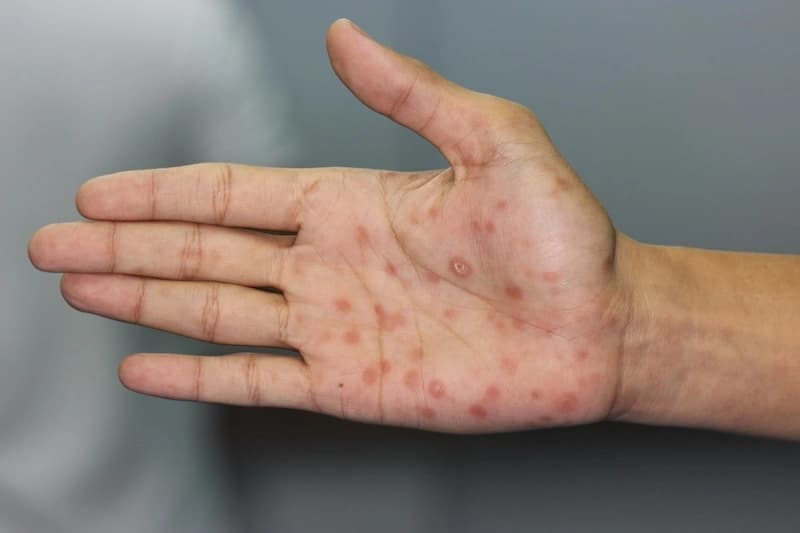
If it's not treated, secondary syphilis appears weeks or months later. Its most characteristic sign is a skin rash that typically involves the palms of the hands and the soles of the feet, a pattern that is uncommon in other diseases. It may be accompanied by condylomata lata (moist, highly contagious lesions in skin folds), fever, sore throat, malaise, headache, hair loss and swollen lymph nodes.4,5 These symptoms also clear up on their own, but the infection persists.
Latent syphilis
This is a symptom-free stage in which the infection shows up only on serology (the blood test). It's divided into early latent (roughly the first year after infection) and late latent (more than a year, or of unknown duration). This distinction matters because it determines how many treatment doses are prescribed.3,5
Tertiary syphilis
Years later, in a proportion of untreated people, syphilis can seriously damage the heart and great vessels, the nervous system and other organs, and form lesions called gummas. In fact, involvement of the nervous system (neurosyphilis) and the eyes (ocular syphilis) can occur at any stage of the infection.4,5 All of this damage is preventable with timely diagnosis and treatment.
How is syphilis detected in a blood test?
The diagnosis of syphilis is, above all, serological: it relies on detecting in the blood the antibodies the body produces against the infection.4,6 There are two broad families of tests, and the key is to understand that they don't compete, they complement each other: each one provides different information.
Non-treponemal tests (VDRL and RPR)
Non-treponemal tests — the VDRL (Venereal Disease Research Laboratory) and the RPR (Rapid Plasma Reagin) — detect antibodies aimed at substances released by the damage the infection causes, not at the bacterium itself.6 They have two important strengths:
- They're cheap, fast and very useful for screening.
- They're reported in titers (for example 1:8, 1:32) that reflect the activity of the infection. This makes them the tool for monitoring treatment: a falling titer indicates a good response, while a rising one suggests active infection or reinfection.4,6
Their limitation is that they can produce false positives (from pregnancy, other infections or autoimmune diseases), so a reactive result is always confirmed with a treponemal test.6
Treponemal tests (TPHA, FTA-ABS, chemiluminescence)
Treponemal tests look for antibodies specific to Treponema pallidum. The best known are the TPHA, the FTA-ABS and modern automated immunoassays by chemiluminescence (CLIA/EIA).4,6 They are highly specific and are used to confirm the diagnosis, but they have one quirk: in most people they stay reactive for life, even after successful treatment. That's why they are not used to assess whether the infection is active or to monitor treatment — that's what the VDRL/RPR titers are for.4,6
Comparison table
| Feature | Non-treponemal (VDRL, RPR) | Treponemal (TPHA, FTA-ABS, CLIA) |
|---|---|---|
| What they detect | Antibodies against tissue damage (not specific to the germ) | Antibodies specific to T. pallidum |
| What they're for | Screening and treatment monitoring | Diagnosis confirmation |
| Result | Reported in titers (rise/fall) | Reactive / non-reactive |
| After cure | The titer falls or turns non-reactive | Usually stay reactive for life |
The screening algorithm: traditional and reverse
Since no single test is enough to make the diagnosis, two are used in sequence. There are two ways to order them, and both are valid:4,6
- Traditional algorithm: you start with a non-treponemal test (VDRL or RPR) and, if it's reactive, confirm with a treponemal test.
- Reverse algorithm: you start with an automated treponemal test (chemiluminescence) and, if it's reactive, run a quantitative VDRL/RPR. It's very practical in laboratories with a high volume of samples.6
In both cases, combining the two tests reduces false positives and makes it possible to tell an active infection apart from a serological scar left by an already-treated one. The final interpretation is always made by a professional, within each person's clinical context.
The window period
The window period is the time between infection and the moment serology can reliably detect it. In syphilis, antibodies can take a few weeks to become reactive, especially in the very early primary stage.4,5 That's why a non-reactive result shortly after a risky exposure may not be definitive, and it's worth repeating the test after a few weeks. If you have a genital ulcer or other symptoms, it's best to see a doctor without waiting.
What do the results mean?
- Non-treponemal and treponemal both non-reactive: no infection detected. If the exposure was very recent, it's worth repeating to rule out the window period.
- Both reactive: this is consistent with syphilis. The stage and treatment need to be determined; the VDRL/RPR titer gives a sense of the activity.
- Treponemal reactive with VDRL/RPR non-reactive: this may be very early syphilis, an old already-treated infection (a serological scar) or latent syphilis. The professional decides what to do based on each person's history.4,6
The laboratory delivers the result, but the clinical interpretation is always done by a health professional.
Treatment: syphilis is cured with penicillin
Syphilis is curable. The treatment of choice, at every stage, is intramuscular benzathine penicillin G.3,5,7 The number of doses depends on the stage:
- Early syphilis (primary, secondary and early latent, less than a year): a single dose of 2.4 million units of benzathine penicillin G.3,7
- Late syphilis (late latent or of unknown duration): three consecutive weekly doses.3,7
In Argentina, benzathine penicillin is available and low-cost, and the Ministry of Health sustains its distribution as part of the response to the rise in cases.2 In people with a penicillin allergy, alternatives can be used in some cases, but penicillin is the only recommended treatment during pregnancy, where — if needed — desensitization is carried out.5,7 After treatment, the response is monitored with the VDRL/RPR over time.
Congenital syphilis and screening in pregnancy
Syphilis passes from the pregnant person to the baby during pregnancy or delivery. Congenital syphilis, when untreated, can cause miscarriage, stillbirth, premature birth or serious damage in the newborn. In fact, the WHO estimates that untreated syphilis in pregnancy leads to adverse outcomes in 50–80% of cases.1
The great news is that this is almost entirely preventable: treated in time during pregnancy, transmission to the baby is avoided in the vast majority of cases. That's why the Ministry of Health and international guidelines recommend testing for syphilis in every pregnancy, several times over the course of gestation.2,5 In Argentina, prenatal syphilis screening is an established practice, and its importance has grown with the rise in cases among pregnant people recorded in recent years.2
Syphilis and HIV: a common co-infection
Syphilis and HIV share transmission routes and often appear together. Having a syphilis ulcer increases the risk of both acquiring and transmitting HIV, and in people with HIV syphilis can behave more aggressively or atypically.4,5 That's why, when syphilis is diagnosed, testing for HIV (and other STIs) is recommended too, and vice versa. In practice, both tests are usually ordered together.
STI testing in Argentina: your rights
Law 27,675 (the National Law on a Comprehensive Response to HIV, Viral Hepatitis, other STIs and Tuberculosis) protects access to testing for sexually transmitted infections, including syphilis. It establishes that testing must be:8,9
- Voluntary: no one can force you to take the test.
- Confidential: both the test and the result are protected.
- Without a doctor's order: your informed consent is enough. No order or national ID is required to access the test.
How and when to get tested at Laboratorio Aclimu
At Laboratorio Aclimu the syphilis test is part of the basic STI check, together with 4th-generation HIV, hepatitis B and hepatitis C. It's done with a simple blood draw, without a doctor's order, confidentially and by online appointment. The result reaches your private patient portal within a few business days.
It makes sense to get tested if you had sex without a condom with a partner of unknown status, if you have a new partner, if you've been diagnosed with another STI, if you noticed an ulcer or rash you can't explain, or simply as part of a routine sexual-health check. Our lab is at Marcelo T. de Alvear 2337, in Recoleta (Barrio Norte), and you can book an appointment online. The service is confidential and straightforward.
This article was reviewed by the biochemistry team at Laboratorio Aclimu. The information is for general guidance and does not replace consultation with a health professional. The diagnosis and treatment of syphilis should always be carried out with a medical team.
Frequently asked questions
Do I need a doctor's order to get a syphilis test?
No. In Argentina, Law 27,675 states that syphilis testing is voluntary and confidential, and your consent is enough: no doctor's order or national ID is required. At Laboratorio Aclimu the test is part of the basic STI check, bookable online and handled confidentially.
What's the difference between the VDRL and the FTA-ABS?
The VDRL (and RPR) is a non-treponemal test: it's used for screening and, above all, to follow up on treatment, because it's reported in titers that rise or fall. The TPHA (and FTA-ABS) is a treponemal test: it looks for antibodies specific to Treponema pallidum and confirms the diagnosis, but usually stays reactive for life. That's why they're used together.
If I've already been cured, will the test come back negative?
Not necessarily. Treponemal tests (TPHA, FTA-ABS) usually stay reactive for the rest of your life, even after a fully successful treatment. What confirms that the treatment worked is not a negative treponemal test but a clear fall in the titers of the non-treponemal test (VDRL or RPR) over time.
How long should I wait after a risky encounter before getting tested?
Serology can take a few weeks to become reactive. In general, testing is suggested from 2 to 6 weeks after an exposure and, if the result is non-reactive but the exposure was recent, repeating the test. If you have symptoms such as a genital ulcer, see a doctor without waiting.
Can syphilis be cured?
Yes. Syphilis is curable. The treatment of choice, at every stage, is intramuscular benzathine penicillin G, and the number of doses depends on the stage of the infection. It's a low-cost treatment, widely available in Argentina, and highly effective when it's given in time.
Why is syphilis screening in pregnancy so important?
Because syphilis passes from the pregnant person to the baby and can cause congenital syphilis, with a risk of miscarriage, stillbirth and serious lifelong damage. Treated in time during pregnancy, that transmission is almost entirely prevented. That's why testing is recommended in every pregnancy, several times.
References
- World Health Organization. Syphilis (fact sheet). Geneva: WHO; 2025. Available at: who.int
- Ministerio de Salud de la Nación Argentina. Syphilis. Buenos Aires. Available at: argentina.gob.ar
- Hook EW 3rd. Syphilis. Lancet. 2017;389(10078):1550-1557. Available at: pubmed.ncbi.nlm.nih.gov
- Ghanem KG, Ram S, Rice PA. The Modern Epidemic of Syphilis. N Engl J Med. 2020;382(9):845-854. Available at: pubmed.ncbi.nlm.nih.gov
- Peeling RW, Mabey D, Kamb ML, Chen XS, Radolf JD, Benzaken AS. Syphilis. Nat Rev Dis Primers. 2017;3:17073. Available at: pubmed.ncbi.nlm.nih.gov
- Peeling RW, Mabey D, Chen XS, Garcia PJ. Syphilis. Lancet. 2023;402(10398):336-346. Available at: pubmed.ncbi.nlm.nih.gov
- Workowski KA, Bachmann LH, Chan PA, Johnston CM, Muzny CA, Park I, et al. Sexually Transmitted Infections Treatment Guidelines, 2021. MMWR Recomm Rep. 2021;70(4):1-187. Available at: pubmed.ncbi.nlm.nih.gov
- Argentina. Law 27,675 — National Law on a Comprehensive Response to HIV, Viral Hepatitis, other Sexually Transmitted Infections and Tuberculosis. Official Gazette; 2022. Available at: argentina.gob.ar
- Fundación Huésped. Syphilis. Buenos Aires. Available at: huesped.org.ar
Tags
Keep reading
Related articles
 Sexual health
1 hour ago
STI and HIV testing in Buenos Aires for travelers
Confidential STI and HIV testing in Buenos Aires for travelers — HIV, syphilis, hepatitis and more, at an accredited lab, results online in days.
 Travelers & expats
7 days ago
Medical tests in Buenos Aires for travelers
Blood work and medical tests in Buenos Aires for travelers and expats: an accredited lab, fast online results and English-friendly service.
 Genomics
9 days ago
DNA ancestry test: where you come from
What a DNA ancestry test measures, how it reads your ancestry by region and by maternal and paternal lineage, and what Argentines carry in their DNA.